
Published by: Techno Bangla Engineering Ltd

Still Maintaining Mechanical Blowers? Upgrade to High-Efficiency Oil-Free Turbo Air Blowers
An in-depth engineering analysis on transitioning from high-friction mechanical blowers to zero-friction, direct-drive turbo blowers to maximize energy efficiency, eliminate downtime, and cut operational costs.
💡 Core Technical Takeaways
Transitioning your plant aeration system from legacy mechanical units to high-speed turbo blowers transforms daily plant economics. Traditional setups bleed energy through transmission friction, requiring around 30 W per m³ of air supplied, whereas direct-drive permanent magnet motors achieve the same volumetric discharge using only 20 to 22 W per m³. Beyond cutting electricity costs by 30% to 40%, switching to zero-friction technology eliminates weekly mechanical maintenance, removes oil contamination risks, and reduces the equipment footprint by up to half.
Energy Consumption, Motor Physics, and Transmission Losses
The primary driver behind replacing mechanical blowers is the significant difference in electrical efficiency and mechanical power draw. Standard mechanical blowers rely on conventional asynchronous induction motors that operate at a modest efficiency range of 85% to 88%. Because these systems operate at standard speeds between 2,000 and 3,700 RPM, they depend on external drive belts, pulleys, speed-increasing gears, and heavy mechanical bearings to drive air displacement. This indirect transmission creates substantial mechanical friction, drawing approximately 30 W of power for every cubic meter of aeration air delivered to the process tanks.
In contrast, advanced turbo blowers utilize high-speed Permanent Magnet Synchronous Motors (PMSM) operating at extreme rotational velocities between 30,000 and 50,000 RPM. By coupling the impeller directly to the motor shaft, all energy losses associated with belts, gearboxes, and sliding mechanical surfaces are completely eliminated. This direct-drive design pushes motor electrical efficiency past 97%, dropping specific energy consumption down to roughly 20 to 22 W per m³ of air. For a continuously operating facility, this efficiency jump translates directly into a 30% to 40% reduction in aeration electricity expenses while maintaining consistent pressure and airflow.
Air Quality, Mechanical Wear, and Maintenance Overhead
Beyond raw energy consumption, operational stability and ongoing maintenance routines differ fundamentally between these two technologies. Mechanical blowers require continuous, labor-intensive upkeep to prevent unexpected breakdowns. Plant technicians must perform weekly bearing re-greasing, monitor and adjust belt tensions, execute regular oil changes, and replace worn seals. Despite meticulous maintenance, the inherent physical friction causes ongoing mechanical degradation, leading to efficiency loss within a few years of installation. Furthermore, mechanical wear creates a persistent risk of sudden belt snapping or bearing failure, causing unscheduled plant downtime, while internal lubrication systems carry a constant risk of leaking oil mist into the process air stream.
Turbo blowers eliminate these friction-related failure points through a contact-free bearing design (utilizing air or magnetic levitation bearings). Because there are no moving parts coming into physical contact during rotation, physical friction is virtually zero. This non-contact operation ensures that the blower maintains its factory-new efficiency rating throughout its operational lifespan. Maintenance is reduced to simple air filter replacements—there is no oil to change, no belts to tighten, and no mechanical seals to replace. This oil-free operation guarantees 100% clean discharge air, protecting delicate downstream biological systems from hydrocarbon contamination while minimizing unscheduled downtime risks.
Control Integration, Physical Footprint, and Carbon Reduction
Managing process fluctuations is another area where modern turbo blowers outperform traditional setups. Mechanical blowers often feature limited speed adjustability, forcing operators to rely on energy-wasting bypass valves or external retrofitted VFDs to regulate pressure. They generate significant operational noise levels ranging from 85 to over 100 dBA and produce heavy structural vibrations that demand reinforced, specialized concrete foundations. Their modular, split-component assembly (motor, pulleys, baseplate, silencers) consumes valuable floor space and complicates initial plant layout design.
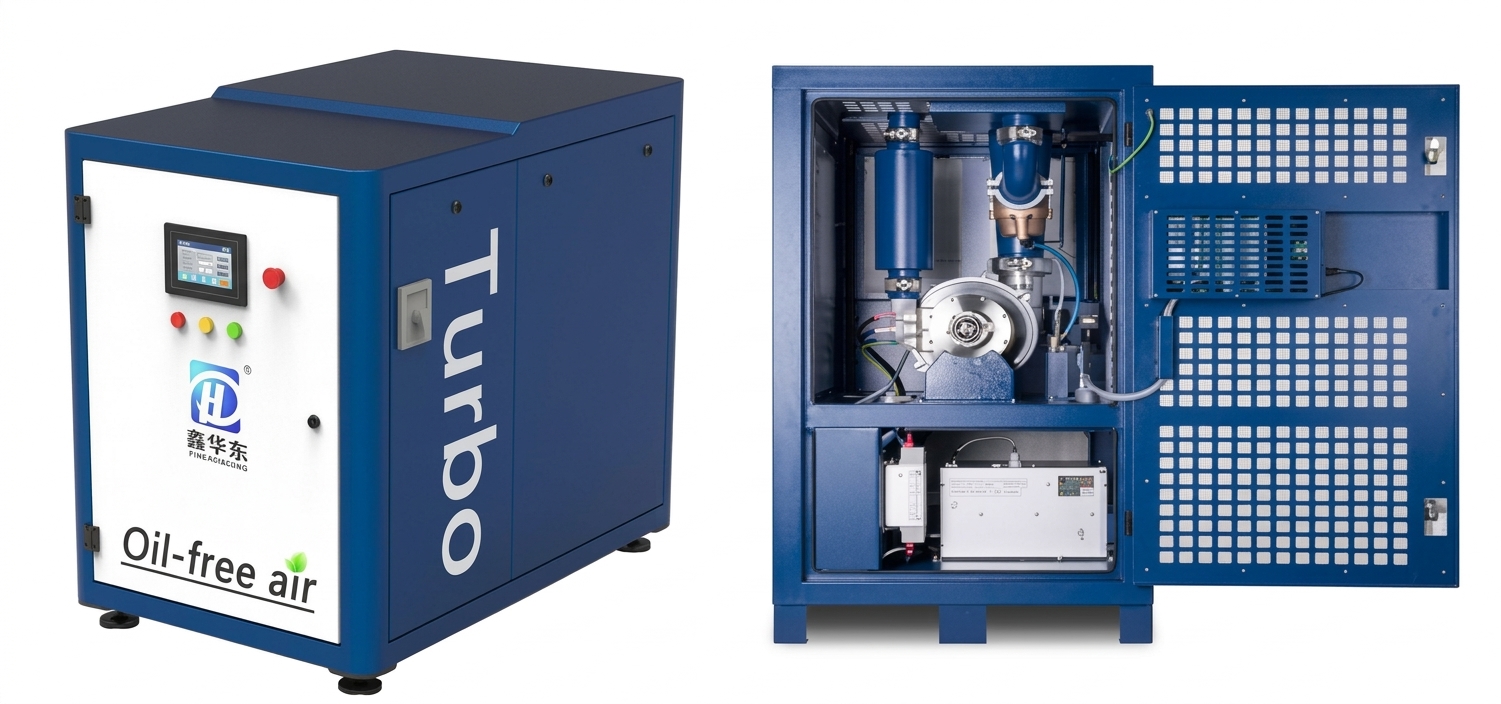
Modern turbo blowers are engineered as compact, all-in-one “plug-and-play” cabinets housing the blower, variable frequency drive (VFD), acoustic enclosure, and PLC controller within a single frame. This integrated enclosure reduces overall floor space requirements by up to 50% and quietens noise levels down to approximately 80 dBA, eliminating the need for expensive vibration-dampening foundations. The onboard smart touchscreen PLC continuously tracks operating parameters—including mass flow, discharge pressure, rotation speed, motor temperature, and surge prevention—and seamlessly integrates with central factory SCADA systems for predictive maintenance. By combining massive power savings with the elimination of hazardous waste oils, upgrading to turbo blower technology significantly lowers your plant’s overall carbon footprint.
Total Cost of Ownership & Strategic Upgrade Summary
While traditional mechanical blowers present a lower initial capital expenditure (CAPEX), their high lifetime operational expenses (OPEX)—driven by constant power draw (~30 W/m³), frequent spare parts replacement, and ongoing maintenance labor—make them costly to maintain long-term. High-Efficiency Oil-Free Turbo Air Blowers require a higher upfront capital investment, but they deliver rapid ROI by cutting aeration power consumption down to ~20–22 W/m³, removing routine maintenance costs, and providing automated SCADA control. For plants focused on long-term operational stability, energy compliance, and reduced environmental impact, upgrading to direct-drive turbo technology represents the ultimate operational investment.